
Battle of Strindfjorden
18 June 1199 – six hours that decided a civil war, off the shores of Hindrum Fjordsenter on the Trondheimsfjord.
Based on Historieglimt 257 by Per Øverland
On the fjord outside Lade stood one of the most important sea battles of King Sverre's reign. It came toward the end of his life, but he had ruled long. Acclaimed as king in 1177, in the two decades that followed he had defeated Erling Skakke and then King Magnus Erlingsson. The realm had known years of relative peace. But in 1196, Bishop Nikolaus Arnesson raised his banner against the excommunicated king, and the civil war flared again for the last time. The two men who faced each other had unusually close family ties to the Norwegian royal house — Nikolaus was the half-brother of King Inge Krokrygg, while Sverre's queen Margrethe, daughter of the Swedish king Erik the Holy, was the bishop's second cousin. Bloodlines crossed, but on Strindfjorden, kinship had to yield to power.
To understand what was at stake, one must unroll a larger backdrop. In 1153, the Norwegian church province was established — one of the largest in northern Europe by extent. The archbishopric of Nidaros governed not only the Norwegian mainland, but an enormous maritime realm: Iceland, Greenland, the Faroe Islands, the Orkney Islands, Shetland and the Sudreys. For generations the church had tried to bring order to Norway's chaotic succession, where the old law gave every king's son the right to claim the royal title at the assembly. The church's desired solution was simple: the eldest legitimate son inherits. Magnus Erlingsson was crowned in Bergen by Archbishop Øystein in 1163 — the church's candidate, the church's solution. But against all odds, the king's son Sverre from the Faroe Islands, Sigurd's illegitimate son, won the contest. Church and state were now on a collision course. Sverre was trained as a priest and well acquainted with theological debates in Europe — including at the University of Bologna, where leading theologians opposed the pope's claim to authority over secular rulers. He stood firm against excommunication and church pressure. Bishop Nikolaus Arnesson had himself been approved as bishop by the same King Sverre he was now fighting. In 1196 he took up the struggle regardless, supported by the old followers of King Magnus and several of the country's most powerful families. The final six years of Sverre's reign were defined by the war between the Birkebeiner and the Baglers — and it culminated on Strindfjorden on 18 June 1199.
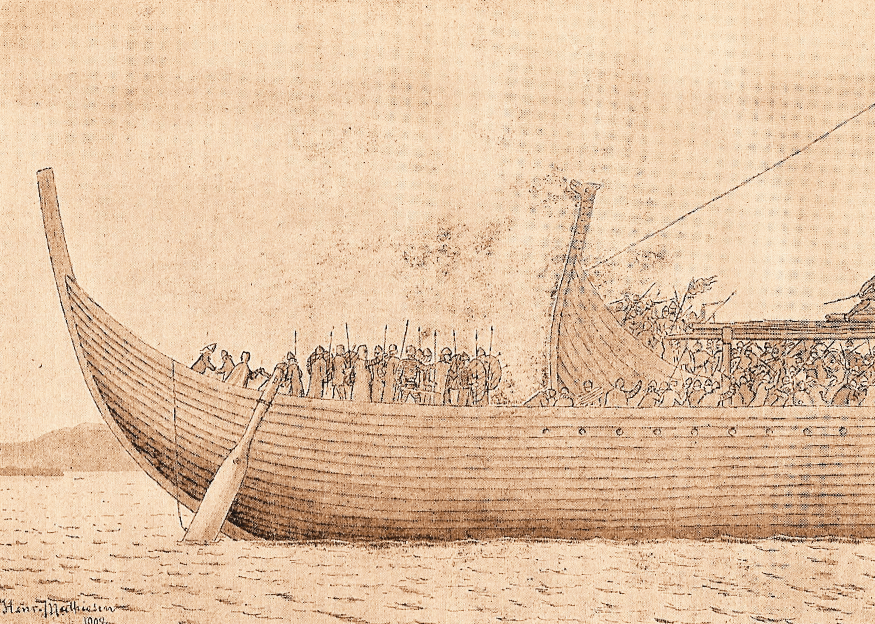
Illustration from 1902 depicting the Battle of Strindfjorden
A historical artistic rendering of the epic sea battle
The Bagler fleet had sailed north from Bergen with the aim of capturing Nidaros. When they learned that Sverre himself was in the city, they abandoned the plan and continued north to Hålogaland to seek support from Bjarkøy. They received it. King Sverre used the late winter to build eight large ships with high sides — ready by Easter. When the Bagler fleet returned to the Trondheimsfjord in early June and anchored at Munkholmen, Sverre was ready.
On the morning of 18 June, the Birkebeiner fleet sailed out from the well-fortified city. The battle at Tautra began at midday and raged for six hours. King Sverre led from his ship — called Hugro, meaning composure. He shot with a crossbow throughout the battle and addressed his men whenever the opportunity arose. Professor Fredrik Paasche writes in his book on King Sverre: the king's leadership bore a great deal of the credit for the victory.
Bishop Nikolaus was the strategist, not the warrior. He kept his ship at the edge of the battle. When he saw which way things were going, he fled out across the fjord with his closest men — Reidar Sendemann and Håkon Jarlssønn among them. Hallvard of Saastad from Stange, one of the Baglers' most capable chieftains, was among the fallen. By nightfall, Sverre and his men were able to row back to the city having cleared six of the Bagler ships.
The bishop's own words before the battle had been contemptuous. Sverre controlled only "a headland", he had said — and the king ought to hang from a gallows there. It did not help. Sverre remained king until he died a natural death in Bergen in 1202. It was the last great sea battle of the civil war era — and it was fought off Amborneset, on the same water you see from Hindrum Fjordsenter today.
The warriors who fought on Strindfjorden that day were laid to rest in the burial mounds nearby. Explore the burial mounds at Amborneset .
The Viking Laws of Wisdom
For those who seek strength in stillness and peace in action.
1. Be brave and present
Meet the moment directly without fear. Seize opportunities when they appear, but be like water – adapt, be agile, flow around obstacles. Focus on one challenge at a time with full presence. Do not plan everything in the smallest detail – trust the wisdom of the moment. Use the best tools you have available.
2. Be prepared in body and soul
Keep your tools sharp and your mind clear. Train the body with respect, not violence. Find good companions who share your values. Agree on what truly matters. Choose one leader when action is required, but remember that the true leader serves the group.
3. Be an honest merchant
Understand what the world needs, not only what you wish to give. Never promise what you cannot keep – your honour is your greatest weapon. Do not demand more than is fair, for greed destroys trust. Treat everyone with respect – tomorrow the enemy may become your ally.
4. Keep the camp in harmony
Let order and cleanliness reflect peace of mind. Create joy and community that strengthens the bonds between warriors. Ensure that everyone contributes their gifts and abilities. Listen to the group's wisdom before great decisions are made – many eyes see more than two.
"The true Viking conquers himself first – then the world opens naturally."